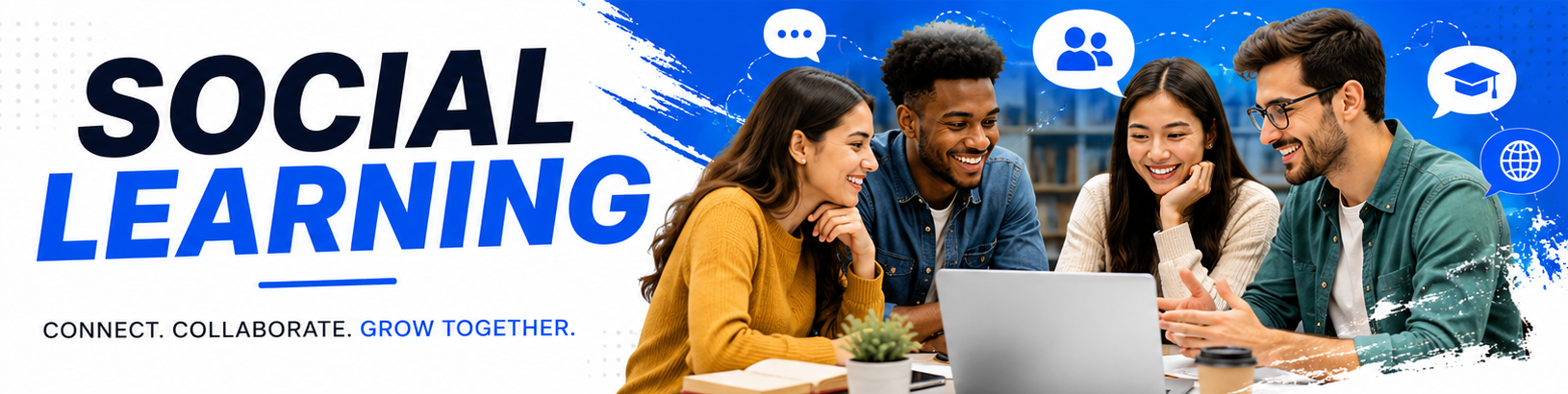
About this course
This course introduces students to the fundamental concepts and practices of Social Learning, essential for understanding how people learn through observation, interaction, collaboration, and shared experiences. It covers social learning theory, modeling behavior, peer learning, digital collaboration, and knowledge sharing in group settings.
Through case studies, group activities, and interactive discussions, learners will analyze how social learning improves knowledge retention, skill development, and workplace collaboration. The course also explores online learning communities, mentorship, and collaborative tools, preparing students to apply social learning principles in educational and professional environments.
Learning Objectives
By the end of this course, students will be able to:
- Explain the fundamental principles of social learning theory.
- Differentiate between individual learning and social/collaborative learning.
- Evaluate the role of observation, imitation, and modeling in learning processes.
- Analyze the impact of peer interaction and group dynamics on knowledge acquisition.
- Identify tools and platforms that support social and collaborative learning.
- Develop strategies for applying social learning in educational and workplace contexts.
Target Audience
- Educators and training professionals.
- HR and organizational development specialists.
- Students and lifelong learners.
- Managers and team leaders.
- Anyone interested in collaborative learning and knowledge sharing.
Course Format
- Lectures & Discussions: Key concepts, theories of social learning, and collaboration models.
- Group Activities: Peer learning and collaborative problem-solving exercises.
- Case Studies: Analysis of successful social learning environments.
- Assessments: Quizzes, group projects, and a final collaborative learning design project.
Expected Outcomes
Upon completion of this course, students will be able to:
- Demonstrate a working knowledge of social learning principles.
- Assess the effectiveness of collaborative learning methods.
- Recommend suitable tools and strategies for group-based learning.
- Develop informed approaches for fostering knowledge sharing environments.
- Bridge the gap between individual learning, collaboration, and collective knowledge growth.